
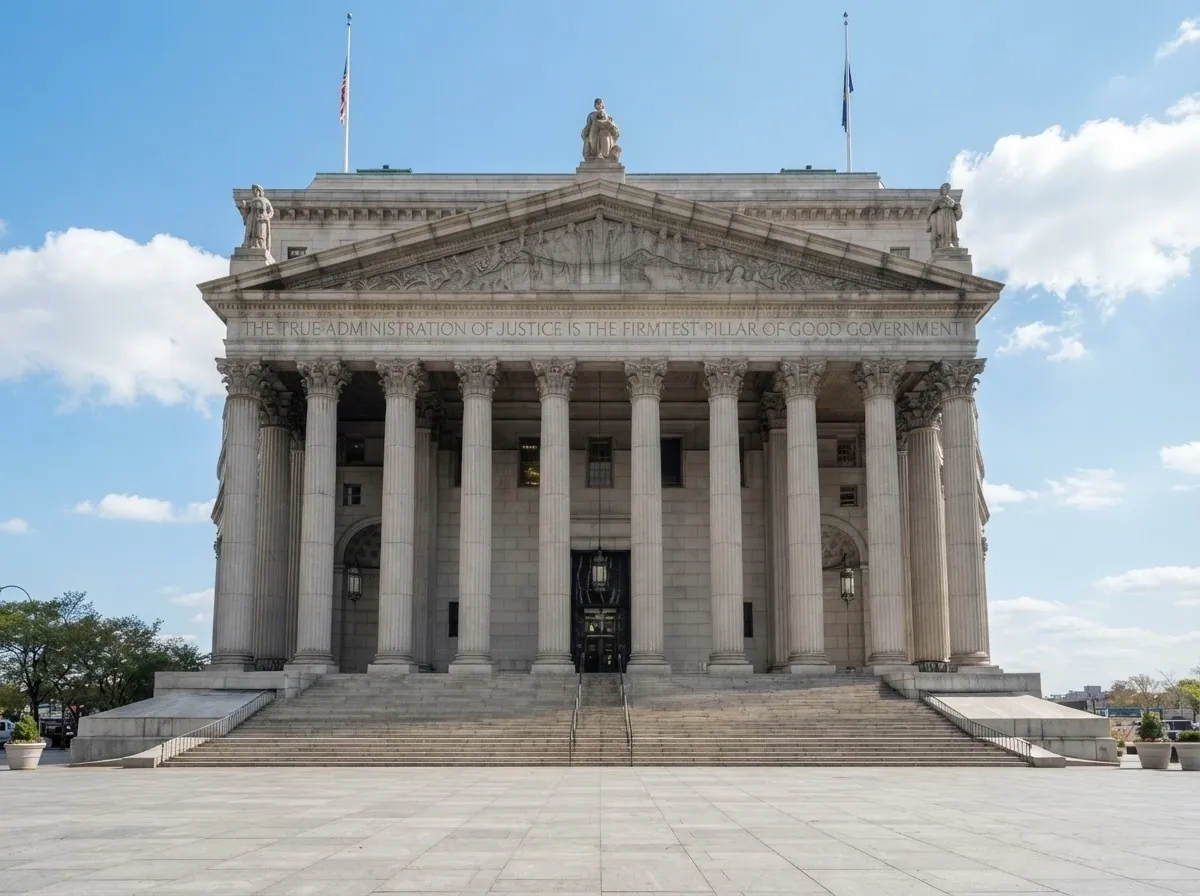
Court records in New York County are maintained by clerks of the respective courts and are accessible through online tools, official court portals, and directly at the offices. NewYorkCourt.us can help find publicly available information about court records in this county. Additionally, you can use New York State portals, the eFiling system, and contact the County Clerk's Office to obtain certified copies of documents.
New York Court System Overview
New York has one of the most complex court systems in the United States. New York County (Manhattan) is part of the First Judicial District of the state. The state's court system includes the Supreme Court—a court of general jurisdiction which, despite its name, is not the highest court and handles serious civil and criminal cases. The highest appellate court is the New York State Court of Appeals. At the county level, there are also the Criminal Court (lower-level criminal cases), Civil Court (civil disputes up to a specified amount), Surrogate's Court (probate matters), and Family Court. Federal cases are heard by the U.S. District Court for the Southern District of New York, headquartered in Manhattan.
Courts Serving New York
State Courts
Federal Courts
What Types of Cases New York Courts Hear
The courts serving New York County handle a wide range of cases:
- Criminal cases: felonies, misdemeanors, violations, and infractions
- Civil disputes: claims of any amount in the Supreme Court; cases up to $50,000 in Civil Court; small claims up to $10,000
- Family law: divorce, child custody, child support, protective orders, paternity establishment
- Probate matters: wills, estate administration, guardianship appointments
- Juvenile matters: juvenile delinquency, child protective proceedings, adoptions
- Traffic violations: handled through the TVB (Traffic Violations Bureau) within New York City
District Court Cases in New York
The Supreme Court of New York County serves as the primary court of general jurisdiction. Serious criminal cases are brought here after a grand jury indictment. Civil claims exceeding the jurisdiction of the Civil Court also begin in the Supreme Court. A judge is assigned based on the case category—Criminal Term or Civil Term. Appeals from lower New York City courts are directed to the Appellate Term of the Supreme Court, First Department. After conviction, a defendant may file a motion for sentence review through the Supreme Court.
Magistrate Court Cases in New York
In New York, the functions similar to a magistrate court are performed by the Criminal Court and Civil Court of the city. The Criminal Court handles misdemeanors, violations, and conducts preliminary hearings in felony cases before they are transferred to the Supreme Court. The Civil Court has jurisdiction over civil cases up to $50,000. A separate Small Claims Part handles claims up to $10,000—the procedure is simplified, and an attorney is not required. Traffic violations within the five boroughs are processed by the DMV Traffic Violations Bureau, not a regular court. DWI cases are heard in the Criminal Court.
Family Law, Probate, and Juvenile Matters in New York
Family Law
Divorces are processed through the Supreme Court, as the Family Court does not have jurisdiction over marriage dissolution. Divorce records in New York can be obtained through the County Clerk's Office. The Family Court handles cases regarding custody, child support, protective orders, paternity establishment, and termination of parental rights.
Probate Matters
The Surrogate's Court is the only court that deals with wills, estate administration, guardianships, and trusts. Each county has its own Surrogate's Court.
Juvenile Matters
The Family Court also handles juvenile delinquency and child protective proceedings. These records are confidential under state law. Adoptions are processed through the Surrogate's Court, and these cases are also closed to public access.
How Cases Move Through the New York Court System
- Case Initiation. A criminal case begins with an arrest or court summons; a civil case starts with the filing of a complaint and payment of a court fee; a family case begins with a petition to the Family Court.
- Judge Assignment. A case is assigned to a specific judge through the Individual Assignment System (IAS) in the Supreme Court. In Criminal Court, cases initially go through the arraignment part.
- Initial Hearings. In criminal cases, the defendant appears at arraignment, where charges are read and bail is set. In civil cases, a preliminary conference is held.
- Pretrial Phase. Parties exchange evidence (discovery) and file motions. In criminal cases, plea bargaining may occur.
- Trial or Resolution. A case concludes with a trial, plea agreement, settlement, or default judgment.
- Post-Judgment. The convicted individual receives a sentence. Any party may file an appeal. In civil cases, judgment enforcement follows.
Court Administration, Local Rules, and Public Access in New York
The state courts in New York County are managed by the Office of Court Administration (OCA), which reports to the Chief Administrative Judge. Local rules for the First Judicial District courts are published on the NYCourts.gov website. Most court records in New York State are public under Judiciary Law § 255, although there are exceptions: juvenile records, sealed criminal cases, and adoption materials are closed to general access.
Hearings in New York County courts are generally open to the public. Some courts offer remote participation via Microsoft Teams or Skype—check with the specific court's office. To request copies of court documents, contact the County Clerk or use the eFiling system through NYSCEF (New York State Courts Electronic Filing).
Court Records and Related Court Resources in New York
- Case Search. The WebCivil Supreme system can be used to search civil cases in the Supreme Court. Criminal cases are available through WebCrims. Both tools are supported on the NYCourts.gov portal.
- Property Records. The ACRIS (Automated City Register Information System) allows searching for property ownership, mortgages, and other records. The office for New York County is located at 66 John Street, 13th floor.
- Property Valuation and Taxes. The Property Tax Public Access portal contains assessment data. Additional information on property taxes is provided by the NYC Department of Finance. Address search is available through the DOF online tool. The state level is served by the Office of Real Property Tax Services.
- Criminal History and Background Check. The Division of Criminal Justice Services (DCJS) maintains official state criminal history records. Individuals can request a review of their own record.
- Police Requests. For police reports, good conduct certificates, or fingerprint results, contact NYPD Record Requests.
- Inmate Search. To locate an individual held in NYC DOC facilities, use the Person in Custody Lookup. For state facilities, use the DOCCS Incarcerated Lookup. The Commission of Correction provides links for county and city jail searches.
- Sex Offender Registry. Available through the Division of Criminal Justice Services, which also provides crime statistics.
- Zoning and Land Use. The ZoLa interactive map from the Department of City Planning allows checking the zoning of any parcel. The zoning resolution text is available on a separate portal.
- Forms and Self-Help. NYCourts.gov publishes forms for self-filing claims, petitions, and motions. Self-Help Centers operate in several court buildings in Manhattan, providing free consultations without court representation.